
Quick Summary
A business growth strategy for complex operations starts with diagnosis rather than tactics. Leaders should score operational complexity across five dimensions, trace one key order end to end, and measure capacity at the constraint before setting growth targets.
- Score process interdependency, data fragmentation, decision rights, capacity variability and external dependency from 1 to 5.
- Trace the highest-volume value stream step by step with the people who do the work.
- Measure current throughput at the constraint before committing to a growth target.
- Limit priority initiatives to two or three, each tied to a named constraint and one owner.
Table of Contents
- Why Growth Strategy Breaks Down in Complex Operations
- Assessing Operational Complexity Before You Set Growth Goals
- Building a Business Growth Plan With Clear Priorities
- Designing Scalable Business Systems Across Teams
- Finding and Removing Operational Bottlenecks
- Choosing Business Growth Metrics That Reflect Complexity
- Selecting Business Automation Tools Without Adding Complexity
- Governance, Execution Cadence and Scenario Planning
- Booking a Growth Strategy Review With Ecommerce Better Buys
- Frequently Asked Questions
Why Growth Strategy Breaks Down in Complex Operations
Last Updated: October 28, 2026
Growth strategies that work for a three-person team often fail once a business runs several product lines, multiple sales channels and a multi-link supply chain.
The core problem is coordination.
Several recurring failure points show up in complex organizations:
- Goals set at the top without operational input. Leadership sets an aggressive revenue target without checking whether fulfillment, staffing or systems can support it.
- Too many initiatives running at once. Attention and budget spread across so many projects that none reaches completion.
- Unclear ownership of cross-team processes. Handoffs between sales, order management and customer service have no single accountable owner.
- Metrics that measure activity, not outcomes. Teams report calls made or campaigns launched rather than customers retained or margin earned.
A common mistake is treating growth as a sales problem when the constraint is internal. Adding demand to an operation that cannot absorb it increases costs, delays and complaints.
A sequence for addressing these breakdowns is to assess complexity, set priorities, design cross-team systems, remove bottlenecks, measure what matters, and establish governance.
Assessing Operational Complexity Before You Set Growth Goals
Before setting growth goals, leadership needs an honest picture of how complex the operation already is. Operational complexity is the number of interdependent processes, teams, systems and external partners required to deliver a sale. The more they depend on each other, the more carefully growth must be sequenced.
Most growth plans fail here because they skip diagnosis. A practical assessment produces three outputs: a ranked list of constraints, a handoff map for the core value stream, and a capacity baseline. Without those, growth goals are guesses dressed as targets.
Run a structured complexity assessment
A workable assessment covers five dimensions. Score each from 1 (simple) to 5 (highly complex) and record the evidence behind the score.
- Process interdependency. How many teams and systems must touch a typical order from first contact to cash? Count every handoff, approval and system of record.
- Data fragmentation. How many systems hold customer, order, inventory or financial data, and how often do those systems disagree? A common pattern is three to five systems with no single source of truth.
- Decision rights. For each cross-team process, is there one accountable owner, or does every decision require a committee? Unowned handoffs are where delays concentrate.
- Capacity variability. Where does work queue, and how wide is the swing between peak and average volume? Wide swings signal that growth will amplify existing bottlenecks.
- External dependency. How many suppliers, partners or channels must coordinate for delivery, and how much control does the business have over their timing?
A total score is less useful than the pattern. High scores on interdependency and data fragmentation usually mean the constraint is coordination, not demand. High scores on capacity variability usually mean the constraint is throughput. The pattern tells you which growth path is realistic this planning cycle.
Trace one order end to end
Pick the highest-volume value stream, such as order-to-cash or returns handling, and walk it step by step with the people who do the work. For each step, record the team, system, input, output and typical wait time before the next step.
The goal is not to count handoffs but to see which carry the most risk of delay or error, then rank them by impact. That ranked list becomes the input to the growth plan.
Establish a capacity baseline
Before committing to a growth target, measure current throughput at the constraint: orders per day at fulfillment, cases closed per week in service, or deals processed per month in finance. Compare that to the demand the plan would create. Adding 20% more volume to a process already at practical capacity produces backlog, overtime and service failures, not growth.
Keep the assessment to two weeks and one page per dimension. The purpose is to choose the right growth path, not to produce a consulting deliverable.
Turn findings into growth guardrails
The assessment should produce a short list of constraints ranked by impact, each with an owner and an early indicator. Those constraints inform which growth goals are realistic next planning cycle and which must wait until the operation is stabilized.
Complexity also differs by business model. A company selling through three channels with separate inventory pools faces different constraints than one with a single storefront.
The assessment rests on five dimensions, each scored from 1 (simple) to 5 (highly complex), so leadership can see where growth will be constrained.
| Dimension | What to check | Pattern to watch |
|---|---|---|
| Process interdependency | Teams and systems touched per order | High scores point to coordination constraints |
| Data fragmentation | Systems holding customer, order, inventory or financial data | Three to five systems with no single source of truth |
| Decision rights | Single accountable owner per cross-team process | Unowned handoffs concentrate delays |
| Capacity variability | Swing between peak and average volume | Wide swings amplify existing bottlenecks |
| External dependency | Suppliers, partners and channels that must coordinate | Limited control over their timing |
Building a Business Growth Plan With Clear Priorities
A business growth plan turns ambition into a sequence of decisions.
Start by defining the growth objective in measurable terms: revenue from a specific segment, margin improvement on a product line, or throughput at a fulfillment point.
A workable structure for the plan includes:
- The objective. One primary outcome for the planning period, with a target and a deadline.
- The constraints. The bottlenecks or dependencies that currently limit that outcome.
- The priority initiatives. Usually no more than three, each linked to a named constraint.
- The owners. One accountable executive per initiative, not a committee.
- The review points. Dates when progress is checked and priorities are reconfirmed.
Many organizations skip step four. Shared ownership sounds collaborative but tends to produce delayed decisions when cross-team trade-offs arise.
The plan should also state what the organization will not do during the period. Explicitly deferring lower-priority work protects capacity for the initiatives that matter most.
Designing Scalable Business Systems Across Teams
Scalable systems let growth add volume without multiplying effort.
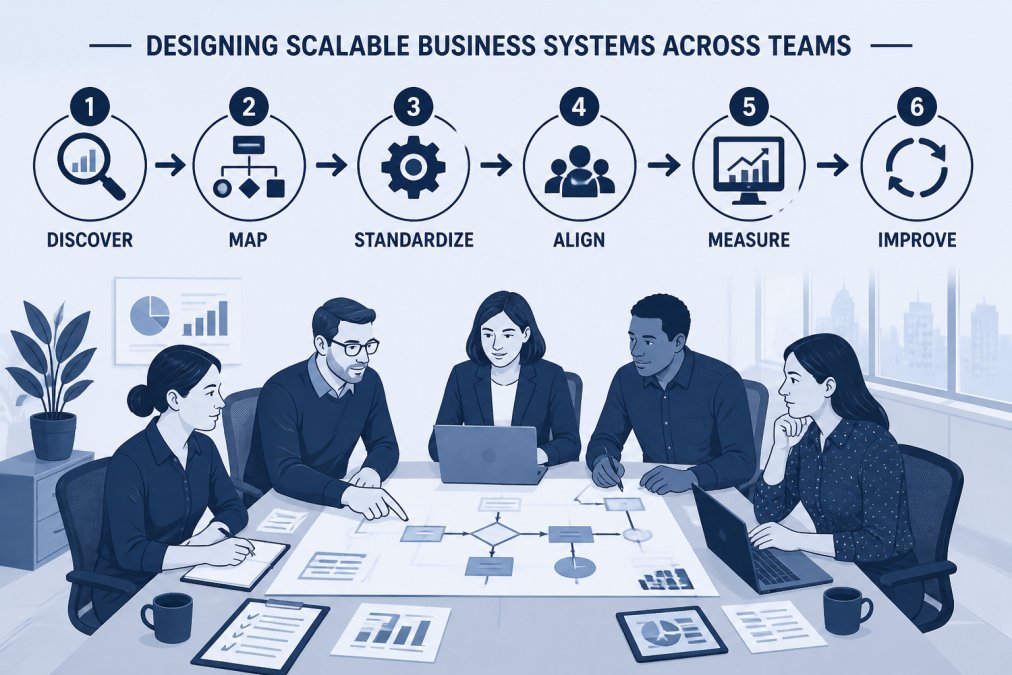
Scalability depends on standardizing what should be the same everywhere and leaving flexibility where it genuinely matters.
Cross-functional working sessions help here.
Automation supports scalable systems but does not replace design. Automating a broken process only produces errors faster.
Common mistakes include buying a system before agreeing on data definitions, and building custom workflows that only one person understands. Either approach makes the operation harder to scale rather than easier.
Finding and Removing Operational Bottlenecks
A bottleneck is the point in a process that limits the output of the whole process. In complex operations, bottlenecks rarely sit where leaders expect.
Identifying the true bottleneck requires data on where work waits. Look for queues, backlogs, rework loops and approval steps where items sit longest.
Once identified, bottlenecks can be addressed by adding capacity at that point, reducing the work that reaches it, or changing the process so less time is spent there.
Let’s connect for general business inquiries. →
Mapping Handoffs Between Teams
Handoffs are where most cross-team delays occur. Each time work passes from one team to another, information can be lost, questions deferred and accountability blurred.
Building the map is straightforward. Take one common process, such as order-to-cash or returns handling, and list each step in sequence.
Improving handoffs usually involves three changes: defining the minimum information each handoff must carry, assigning a single owner for each transition, and setting a service expectation for how quickly the receiving team acknowledges and acts on work.
Choosing Business Growth Metrics That Reflect Complexity
Metrics shape behavior, so a complex business needs measures that reflect how its parts interact.
A balanced set typically includes a few outcome measures and a small number of operational measures that explain them. Outcome measures might include net revenue growth, gross margin by segment and customer retention.
Conversion rate is one useful input.
Each metric should have a defined owner, a clear calculation method and a target range. Metrics without owners tend to be reported and then ignored.
Selecting Business Automation Tools Without Adding Complexity
Automation can reduce manual effort and improve consistency, but every new tool adds integrations, training needs and failure points.
Evaluate candidate tools against the constraints identified earlier. Does the tool remove a documented bottleneck or handoff delay? Does it integrate with existing systems, or create another data silo?
Pilot tools with a single process and a defined group before expanding. Measure the effect on cycle time and error rates against the baseline.
Many providers offer overlapping capabilities, and selection should be based on fit with the operation rather than feature counts.
Governance, Execution Cadence and Scenario Planning
Governance defines who decides what, and how often those decisions are revisited. In complex organizations, growth initiatives often stall not because the strategy is wrong but because no forum exists to resolve cross-team trade-offs. A growth plan without governance is a document; with governance, it is an operating system.
Define decision rights before the first review
For each priority initiative, name one accountable executive, the teams that must contribute, and the decisions that executive can make without escalation. Cross-team trade-offs, such as prioritizing a large account that strains fulfillment versus protecting service levels for existing customers, need a named decision-maker and a deadline.
Record escalation paths in the plan itself: which issues go to the operating review, which go to the executive team, and what response time each tier carries. Unowned escalations are where growth plans quietly stall.
Set an execution cadence that matches the operation
A practical cadence has three layers:
- Weekly initiative stand-up (30 minutes). Each initiative owner reports progress against the next milestone, current blockers, and decisions needed. No status theater; only exceptions and asks.
- Monthly operating review (90 minutes). Leadership reviews the priority initiatives, the complexity-aware metrics, and any constraint that has tightened. Decisions are recorded with their rationale so later reviews can test whether the reasoning still holds.
- Quarterly planning session (half day). The team reconfirms objectives and constraints, retires initiatives that no longer address a constraint, and selects the next set of priorities. This is also where scenario assumptions are updated.
Keep the number of priority initiatives small enough that the monthly review can cover each one in depth. A common pattern is three initiatives per quarter; more than that and the review becomes a reporting exercise rather than a decision forum.
Model scenarios instead of assuming steady growth
Scenario planning strengthens this process. Rather than assuming one growth path, the team models two or three plausible futures and identifies what would change in each. A workable method:
- Name the scenarios. Typical choices are a slower demand period, a supplier or capacity disruption, and the loss of a major channel or customer. Keep to three so the analysis stays usable.
- Identify the drivers. For each scenario, state which variables move: order volume, staffing availability, cash conversion cycle, supplier lead time, or channel mix.
- Trace the constraint. For each scenario, note which constraint would tighten first and which initiatives would need to pause or accelerate.
- Set early indicators. Define the metrics and thresholds that would signal a shift, such as two consecutive weeks of backlog growth or a drop in on-time fulfillment below target.
- Pre-decide the response. Agree in advance what the team will do if an indicator triggers, so reaction time is measured in days rather than quarters.
This preparation shortens reaction time when conditions change. Resilience comes from enough flexibility to adjust priorities without restarting the whole plan. Organizations that review scenarios regularly change earlier and with less disruption.
Scenario planning is not forecasting. The goal is not to predict which future occurs but to make the organization fast to respond whichever one does. Teams that treat scenarios as predictions tend to defend a single path instead of preparing for several.
Connect governance to complexity-aware metrics
Governance only works if the review forum sees the right numbers. Pair each priority initiative with one outcome measure and one or two operational measures, such as cycle time, on-time fulfillment rate, utilization at the constraint, or the share of orders requiring manual intervention.
When an initiative misses its milestone, the review should ask whether the constraint moved, whether the owner lacked decision rights, or whether the initiative was the wrong response to the constraint.
Booking a Growth Strategy Review With Ecommerce Better Buys
Working through these steps internally is possible, but many leadership teams find it useful to have an outside review of their complexity assessment, priorities and handoff maps. Ecommerce Better Buys offers growth strategy engagements for businesses that want help diagnosing constraints and building an execution plan their teams can sustain. Explore our services to see what a growth strategy engagement covers, or get in touch with the team below.
If you are still building your priorities, our guide on how to choose a strategic consulting firm that delivers explains what to look for in an outside partner. For the measurement side of the plan, our article on how to improve sales conversion rates covers the funnel metrics that connect sales activity to operational capacity.
Let’s connect for general business inquiries.
Frequently Asked Questions
How do you create a business growth strategy for complex operations?
Start by documenting how work actually moves through the business, from order intake to fulfillment, reporting and customer support. Identify where decisions stall, which teams depend on each other, and which steps rely on one person. Set growth goals only after you know how much volume the current structure can absorb. Then choose two or three priorities, assign owners, and review progress on a fixed schedule. Keep each priority tied to a measurable operating outcome so the strategy can be tested rather than simply described.
How can a business scale without making its operations more complicated?
Scale by standardizing repeatable work before adding volume. Write down the steps for core processes, assign clear ownership, and remove approvals that do not change outcomes. Build documented systems for inventory, order handling and customer communication so new staff can follow them without constant supervision. Add tools only where they replace manual steps that already work. Measure cycle time and error rates as volume grows to confirm that complexity is not rising faster than revenue.
What operational systems should a company build before it grows?
Prioritize systems for order and inventory management, customer records, financial reporting and staffing or capacity planning. Each should have a single source of truth, defined inputs and outputs, and an owner responsible for data quality. A basic cadence of weekly operating reviews helps leaders see problems early. Build the systems that would fail first under higher volume, and document them so they survive turnover and do not depend on one person’s memory.
What metrics should businesses track when scaling operations?
Track a small set of measures that connect growth to operating health: order volume against fulfillment capacity, cycle time for key processes, error and return rates, customer retention, and contribution margin by channel. Add a measure of how often work requires manual intervention. Review these metrics together rather than in separate reports, since a gain in sales can hide a rise in fulfillment cost or support load. Keep definitions consistent across teams so the numbers can be compared over time.
When should a business automate or standardize its processes?
Standardize a process once it runs the same way most of the time and the variation is causing errors or delays. Automate it when the steps are stable, the volume is high enough to justify the setup effort, and the data inputs are reliable. Automating an unclear process usually locks in its problems. Test the standardized version with a small team first, measure the result, and expand only if the error rate and cycle time improve.
How often should a company review its growth strategy?
Review operating metrics weekly or monthly, and review the full growth strategy quarterly. Quarterly reviews should check whether priorities still match market conditions, whether systems are holding up under current volume, and whether the assumptions behind growth targets are still valid. Revisit the plan sooner if a major customer, supplier or channel changes. Each review should end with a short list of decisions, owners and dates rather than a general summary.
